
Face Shape Detector — Find Your Face Shape Free From One Photo
Upload one photo and this face shape detector tells you which of the seven shapes you are — oval, round, square, oblong, heart, diamond or triangle — with a match percentage for every shape, measured from 478 facial landmarks, entirely on your device. The three outline ratios behind your result, the exact classification bands, and what each shape means for styling are all explained below.
🔒 Free measuring runs entirely on your device. When you unlock the AI deep report you can choose to attach your photo — used only to generate that one readout, then discarded, never stored. Scores are geometric measurements, not a judgement of your worth.
What "face shape" actually measures
Face shape is the geometry of your face outline, reduced to three ratios:
| Ratio | What it compares | What it separates |
|---|---|---|
| Face index | face length ÷ face width | long vs. short faces (oblong, round) |
| Jaw ratio | jaw width ÷ face width | strong vs. tapered lower face (square, heart) |
| Forehead ratio | forehead width ÷ face width | where the face is widest (diamond, triangle) |
Two faces with identical features look completely different if one is long and narrow and the other is short and wide — that's why shape comes before feature-level advice. Hairstylists, eyewear fitting and beard guidance all start here: the shape decides what "balance" means for your face.
The 7 face shapes
Oval
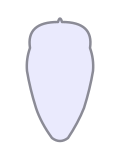
Length is about 1.5× the width, with a softly rounded jaw and no single dominant region. The oval face is the "reference distribution" every other shape is named against — most classic style advice silently assumes it.
Round
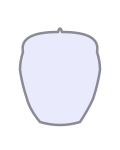
Length is close to the width (face index under ~1.3) and the jaw stays soft. The outline is a circle more than an oval; angular lines — square glasses, structured haircuts — add the definition round faces naturally lack.
Square
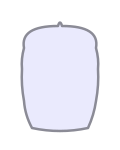
The jaw is nearly as wide as the cheekbones (jaw ratio ~0.92 or higher) and the forehead keeps up. The silhouette reads as three stacked boxes. Soft, rounded styles balance a square face the same way angular styles balance a round one.
Oblong
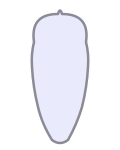
Length clearly beats width (face index ~1.35 or more) — a stretched version of the square or oval, sometimes called rectangle. Styles that add width at the sides and avoid extra vertical height bring an oblong face back into proportion.
Heart
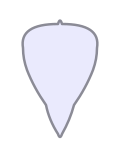
Wide forehead, tapered jaw, pointed chin — the forehead-to-jaw drop is the signature (roughly 0.14+ of face width). Bottom-heavy styles and chin- or shoulder-length layers add weight to the narrow lower half; a shaped beard does the same for men.
Diamond
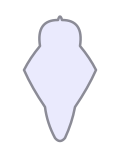
The opposite problem from square: both forehead and jaw are notably narrower than the cheekbones. The face reads as angular and dramatic. Styles that leave the forehead visible and add width at the hairline suit diamonds best — it's the rarest of the seven.
Triangle
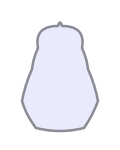
The jaw is the widest line and the forehead the narrowest — the face widens as it goes down, which is why it's also called pear shape. Volume above the jawline — fuller hair on top, statement earrings, broader necklines — rebalances a triangle face.
How this face shape detector actually works
A serious detector doesn't guess from a thumbnail — it measures. The engine marks 478 landmarks on your photo (in your browser, on your device), takes the three ratios above, and applies fixed classification bands:
- Face index ≥ 1.35 → oblong (length dominates everything else)
- Face index ≤ 1.15 with a soft jaw → round
- Jaw ratio ≥ 0.92 with a present forehead → square
- Forehead − jaw ≥ 0.14 → heart (the taper is the signature)
- Forehead ≤ 0.80 and jaw ≤ 0.84 → diamond (cheekbones widest)
- Jaw − forehead ≥ 0.10 → triangle
- Everything else → oval
The bands are broad on purpose: they are community-standard cut points, not a horoscope. The same photo always produces the same shape — the classifier is deterministic, and the input ratios come from the same measurement run as your PSL score, so nothing is estimated twice. If your ratios land near a cut point, the result card says borderline instead of pretending the call is obvious.
How to take a photo the detector can measure
The classifier is only as good as the geometry it can see. Five rules cover it:
- Face the camera straight on — head rotation distorts the face index more than any other ratio.
- Pull hair off your forehead — the detector needs the hairline to find the forehead width.
- Neutral expression, mouth closed — a smile lengthens the lower face and shifts the jaw reading.
- Even, front-facing light — heavy side shadows soften the jaw edge and blur the outline.
- No glasses, no filters — anything that redraws the eye or jaw line changes real measurements.
Related tools and guides
- Attractiveness test — the full 1–10 rating, percentile and 8-metric breakdown
- Golden ratio face calculator — your three φ ratios on the Farkas reference grid
- Canthal tilt calculator — your eye angle in degrees
- Facial ratios calculator — every ratio the engine reads
- PSL calculator — the full 8-metric PSL calculator
- PSL score — what the number means
- PSL scale — the full scale, tiers and methodology
- Hunter eyes — the eye-area ideal, measured honestly
- Methodology — every reference value and weight we use
- Looksmaxxing dictionary — the full glossary
References
Farkas LG, Hreczko TM, Katic MJ. Craniofacial norms in North American Caucasians. In: Farkas LG (ed). Anthropometry of the Head and Face. 2nd ed. New York: Raven Press; 1994 — the anthropometric norms (face index, jaw and forehead ratios) the reference bands are cross-checked against.
FaceRuler. Methodology: metrics, reference values and weights. The full engine specification, including the shape classification bands used above — see methodology.
Detect your face shape in seconds
One photo, on your device, no sign-up — your shape, attractiveness rating and full metric breakdown in a single run.
Run the free face shape detector